This is the knowledge that the taxpayers, businesses, and professionals should have about the TDS Rate Chart 2025-26 to make sure that they comply with the taxes. Tax Deducted at Source (TDS) is a system whereby tax is deducted upon the generation of the income and is useful in ensuring that the government has a way of collecting revenue in a timely fashion.
In the current rates and threshold limit, the government has made changes in the financial year 2025-26 (assessment year 2026-27). This guide describes all that you need to know in an easy and organized manner.
What it is and How It Works
TDS (Tax Deducted at Source) is a system in which the payment is made to the payer (deductor), who will deduct the tax and then pay the payment to the receiver (deductor). This is in the case of income like salary, interest, rent, commission and professional fees.
The amount so deducted is deposited with the government and the deductee is given credit as he/she files income tax returns.


Key Features of TDS Rate Chart 2025-26
The TDS rate chart 2025-26 is laid out in sections according to the income tax act. Major points of interest will be:
- Varying rates of TDS depending on kind of income.
- Different conditions of residents and non-residents.
- Setting threshold limits on deduction.
- Amended regulations came with Budget 2025.
Recent amendments have raised some threshold limits, as well as relaxed compliance by tax payers.
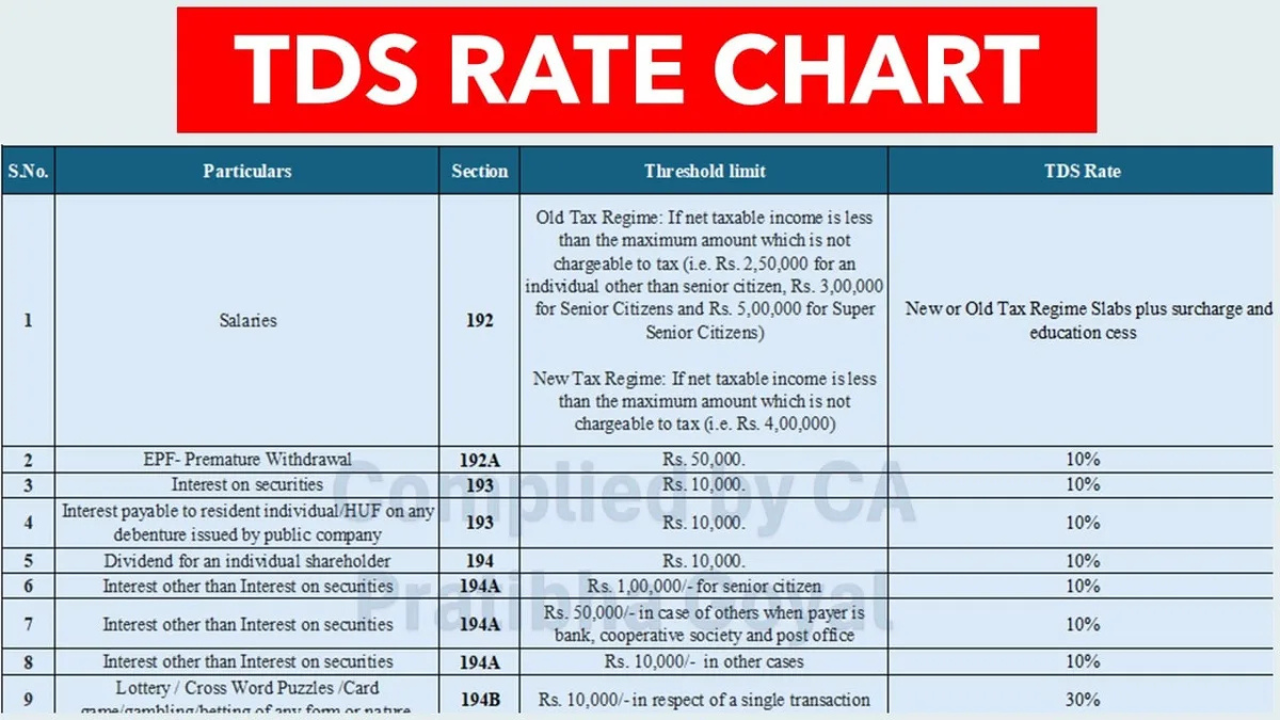
TDS Rate Chart 2025-26 (Section-Wise Overview)
The important TDS rates have been simplified section-wise as shown below:
1. TDS on salary (Section 192).
- Deductible under the applicable rates of income taxes.
- None of the definite percentages.
2. TDS on Interest Income (Section 194A, 193)
- The interest on securities: 10%.
- Interest to bank/post office: above threshold 10%.
3. TDS on Dividend (Section 194)
- 10 percent on dividend over and above prescribed limit.
4. TDS on Contractor Payments (Section 194C)
- 1% for individuals/HUF
- 2% for others
5. TDS on Professional Fees (Section 194J)
- Professional services 10%
- Technical services 2%
6. TDS on Rent (Section 194-I)
- Plant and machinery 2%
- 10% for land/building
7. TDS on Property Purchase (Section 194-IA)
- 1 percent on over 50 lakh transactions.
8. TDS on Purchase of Goods (Section 194Q)
- 0.1% when the turnover is above threshold.
Important TDS rate also depends on the nature of income and there is no universal rate.
Read Also: Webinbound com: A Complete Guide to Guest Posting and SEO Growth
Threshold Limits for TDS Deduction
TDS is only used in cases where payments are above some limits. For example:
- Interest revenue: 50000 (100000 in the case of senior citizens)
- Rent: ₹2,40,000 annually
- Payments to the contractor: 30,000 every transaction.
Importance of threshold limits is that the government has to avoid tax deduction on small payments.
TDS Rates for Residents vs Non-Residents
The TDS rates are different in case of residents and non-residents:
- Standard rates according to sections: residents.
- Non-residents: Special rates or higher rates.
As an illustration, 20% TDS can be charged on payment to non-residents such as sports professionals.
Moreover, TDS can be deducted at a high rate (typically 20%), in case PAN is not provided.
Important Changes in TDS Rate Chart 2025-26
Recent changes in the TDS Rate Chart 2025-26 are:
- Raised interest revenue thresholds.
- Less brokerage expense (Section 194H).
- New provisions such as Section 194T (partner payments) were introduced.
- Streamlining of compliance policies.
The objective of these changes is to enhance the cash flow and decrease the tax burden among individuals and businesses.
Compliance Requirements for TDS
In order to remain compliant, tax payers are required to observe the following steps:
- Tax deductions at the right rates.
- Make a deposit on terms of due date.
- File TDS returns (Form 24Q, 26Q)
- Keeping of proper records and PAN details.
The penalty and interest can be imposed upon non-compliance.
Common Mistakes to Avoid
- Use of wrong TDS rates.
- Not meeting deposit due dates.
- Not following threshold limits.
- Failure to take PAN details.
By preventing such errors, one will have a hassle-free process of tax filing and avoid penalties.
Benefits of Understanding TDS Rate Chart 2025-26
- Improved taxation planning.
- Escape prosecution.
- Better financial transparency.
- Less difficult adherence to tax regulations
Final Word
The TDS Rate Chart 2025-26 is essential in making sure that there is adequate deduction and adherence of the tax. It should be noted that individuals and businesses should be informed of the new rates, thresholds and provisions. Knowledge of TDS will not only prevent punishment, but also have an easy time in financial management and planning of taxes.
FAQs
1. What is the TDS of FY 2025-26?
It does not have a rate but it ranges between 0.1 percent and 30 percent depending on the nature of the transaction.
2. Does TDS apply to any payments?
No, TDS is only applicable to specified payments that are beyond limit in terms of threshold.
3. What will be the case when PAN is not supplied?
TDS is billed at a premium rate, which is normally 20%.
4. What is the maximum level of TDS?
It is determined by the character of payment, including 50000 in interest earnings.
5. How to verify my TDS deducted?
You may enquire about it at Form 26AS or at income tax portal.
Read More: Techcarz com: A Platform for Technology News, Gadgets and Future Innovations